
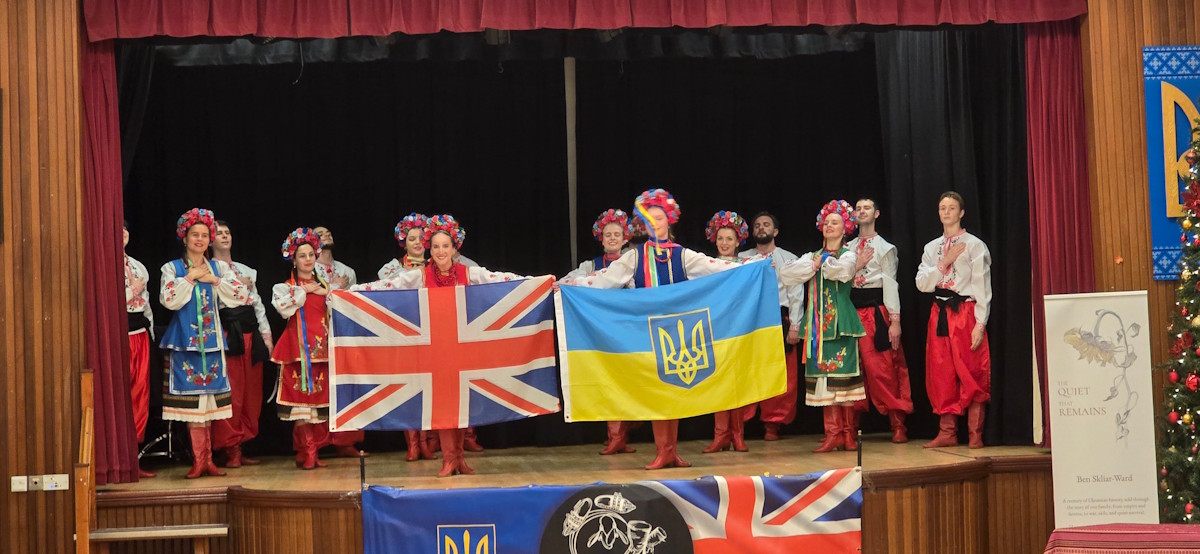
Saturday night was the formal launch of The Quiet That Remains, and I’ve been thinking about what it meant. Not the logistics, or the technology challenges (they happened), or the nerves that come with speaking in front of a crowded room (they exist) - but something deeper.
It mattered that this launch didn’t take place in a bookshop or a conference room. It happened in a space full of Ukrainian music, dance, wine, and community. The kind of space where culture is central, visible and present - the point.
And perhaps that’s why the evening felt significant. Because this book began not with a neatly preserved family story, but with fragments; half-remembered anecdotes, blurred edges, and long silences.
It began with a suitcase.
The suitcase that “wasn’t meant to be opened”
I grew up hearing about a suitcase hidden in a cupboard. It wasn’t spoken of often, and when it was, the references were vague: “not meant to be opened”, “something for later”, “one day”.
It sounded more like a metaphor than an object. A way of not talking about difficult history.
But it turned out to be real.
A few years ago, while helping my aunt clear my grandmother’s flat, I found it at the back of a nearly empty cupboard. Inside were documents. Clues. A birth certificate from Poltava, a tsarist passport with the imperial eagle. Soviet military papers. Nazi travel permits. A refugee card. Photographs. Scraps of handwriting.
It wasn’t a family tree; it was the outline of a century.
That discovery shaped the book precisely because it offered questions rather than neat conclusions.
The foundations of a story
My background is in European political history – the kind usually approached through treaties, geopolitical shifts, and state decisions. In that framing, Ukraine becomes an abstraction: numbers, borders, military movements. The lives inside those abstractions often disappear.
But the suitcase suggested another way of seeing.
What happens if you take the lived experiences – the fear, endurance, compromise, the ordinary decisions made under pressure – and treat those as the centre of the story?
What if instead of asking what Ukraine “is” as a geopolitical object, you ask what Ukrainians lived through, remembered, preserved, or were forced to silence?
Curiosity alone wouldn’t have made me write a book. But my day job nudged me. Working in financial sanctions, I spend a lot of time discussing the current war. Too often, the conversation collapses into a shorthand: a “Putin problem”, a post-Soviet question confined to the last decade. NATO. Crimea. 2014. 2022.
Very rarely does anyone mention the century that came before.
And yet decisions today are shaped by histories most people don’t see – or don’t know. I wrote the first draft of my speech a few weeks ago, before the latest US peace-plan proposals emerged. Reading those proposals, the absence of historical context was striking. Policymaking works best when it recognises historical patterns and the risks that emerge when they’re overlooked.
The unquiet echoes from the last century
One thing that struck me while researching this book is how differently the West and Ukraine remember the twentieth century.
In much of Europe, it sits in sealed chapters: the First World War, then the 1930s, then the Second World War, then the post-war period. Each bracketed. Each self-contained.
For Ukrainians, the twentieth century does not sit neatly behind them.
The 1930s were not only the decade of appeasement abroad, but of famine, terror, repression, and silence at home. Villages were reshaped through fear; cultural elites were erased; identity was suppressed.
The 1940s were not only a time of liberation or occupation depending on what map you look at, but also of mass displacement, forced labour, deportation, and dislocation – the kind that takes generations to make sense of.
The post-war decades were not an era of stability, but a long period of caution and quietness. Generations grew up learning that safety depended on saying less.
This history reaches forward in ways that are easy to overlook. It shaped why Ukraine resisted so fiercely in 2022. Outsiders saw a smaller country facing a larger one and assumed the outcome. Many Ukrainians saw something else: a long pattern, with familiar stakes.
Why small, quiet stories matter
This book is about that pattern – not from the perspective of governments, but from the view of ordinary people who had limited choices, and often even less power to explain themselves.
It is a story of Cossack descendants in the 19th century trying to preserve autonomy; villagers in Poltava during collectivisation; the tightening noose of quotas and fear; the hunger and coercion that made the Holodomor possible; conscription, war, and displacement; the DP camps in Germany; and an unexpected beginning in Britain.
Across all of it runs a set of themes that I didn’t choose so much as uncover: fear, silence, compromise, endurance – and the quiet ways identity persists.
These aren’t dramatic stories in the traditional sense. They are smaller ones, made of fragments, gestures, and habits of survival. But they reveal why people resist; why communities endure; why autonomy means so much; why history rhymes.
Where the story meets the present
Which brings me back to last night. The launch wasn’t simply about introducing readers to a book. It was about situating the book inside the culture that shaped it.
There was music, dance, embroidery, wine – all the elements of continuity that survive even when history turns violent.
It reminded me that the stories in the suitcase were never just personal. They belonged to a wider history, and a wider present.
And that’s what I hope the book offers: a way of seeing Ukraine not only through headlines or geopolitics, but through the experiences of people who lived through upheaval and preserved something essential through it all.
A final note
All my proceeds from the launch are going to British-Ukrainian Aid, an organisation supporting people whose present is still shaped by the histories this book traces.
If The Quiet That Remains does anything, I hope it helps readers feel the human, everyday Ukraine behind the headlines – a country shaped by endurance, continuity, and quiet forms of defiance.
Thank you for reading, and for being here at the beginning of whatever this newsletter becomes.
Related: The Quiet That Remains · An Introduction · Essay index ·