
The name is what stops me.
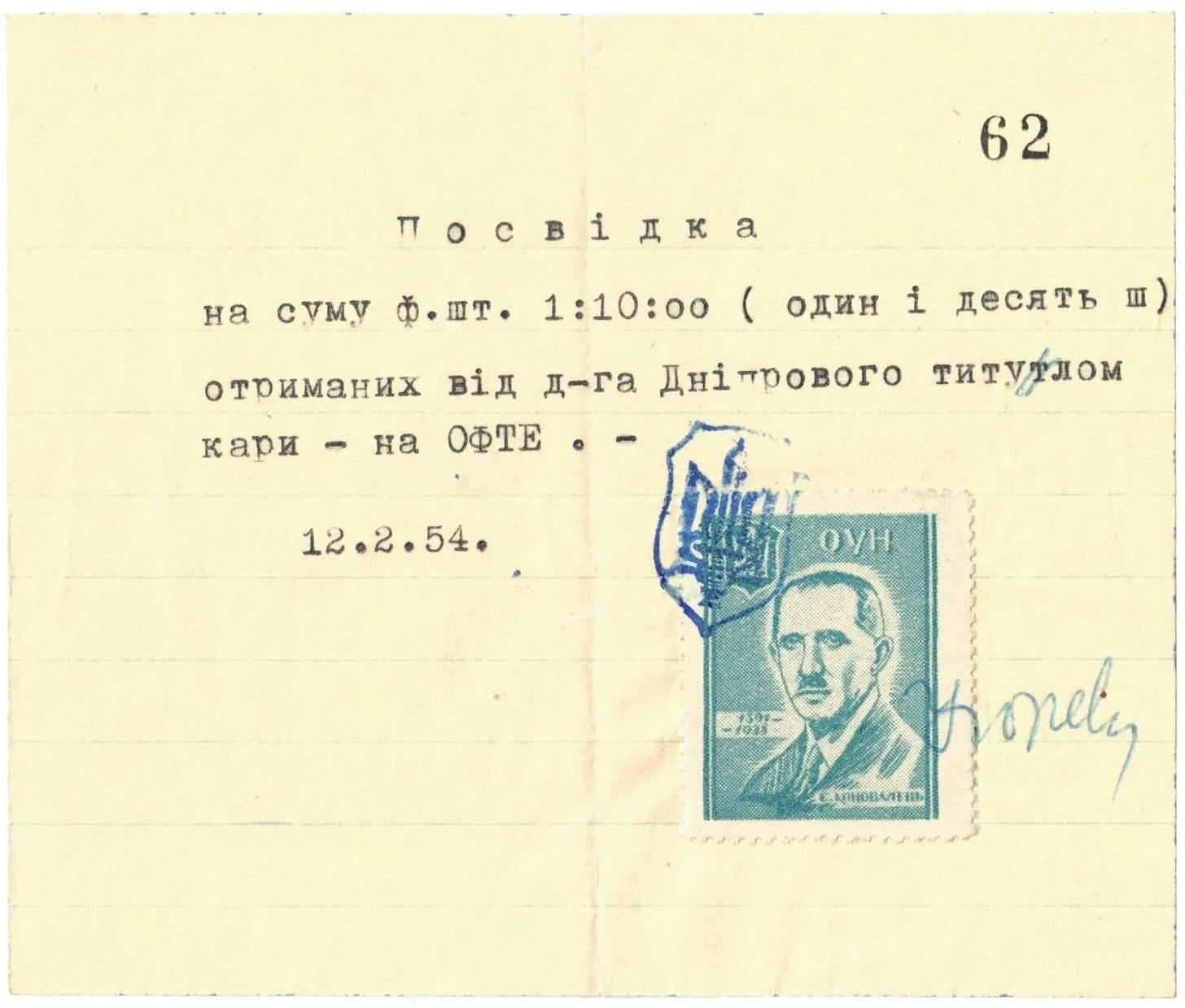
Among the papers stored by my grandfather, Wsewolod Skliar, at one time in the suitcase at the back of the cupboard, is a Ukrainian-language receipt dated 12 February 1954. It records a payment of £1 10s. The document is stamped, signed, and numbered. It sits among other organisational papers from exile political groups in London. Everything about it looks routine, except for the name written where a payer should be.
It reads: “Mr. Dniprovy”.
When I wrote The Quiet That Remains I missed this detail; this document.
At first glance, the receipt appears mundane, aside from its eye-catching stamp. Yet from this single document a series of biographical details emerge. It records participation. It shows how a life intersected with structures that left few other traces. It preserves action without explanation.
The receipt was issued by the Organisation of Ukrainian Nationalists, operating in exile in the United Kingdom. The payment is logged as a disciplinary levy and allocated to the organisation’s Territorial Executive fund (ОФТЕ). Discipline of this kind presupposes inclusion, functioning only inside a shared framework of rules, expectations, and authority. The document places Wsewolod within the organisation’s internal life in 1954, subject to its procedures and code of conduct.
In Britain during the early 1950s, the OUN functioned less as a clandestine revolutionary body than as a tightly organised exile institution. Its members lived openly as refugees, workers, and professionals, while maintaining parallel political structures that preserved hierarchy, discipline, and collective purpose. Funds were raised and administered, conduct was monitored, and disputes were regulated through formal mechanisms. In this environment, paperwork carried particular weight. Receipts, fines, and minutes provided continuity and legitimacy at a moment when territorial sovereignty remained out of reach.
The sum itself, £1 10s, represented a noticeable expense in postwar Britain, especially for someone rebuilding life after displacement, while remaining affordable. The organisation asserted standards while sustaining participation.
The most revealing detail appears where the payer’s name should be. The receipt records payment by “Mr. Dniprovy.” The use of aliases was common within exile organisations, including in financial records. The alias must have functioned stably enough to be used in disciplinary accounting, carrying some form of recognition within the group.
Taken at face value, “Dniprovy” situates identity geographically. It points toward the Dnipro basin, central and eastern Ukraine, rather than toward faction or rank. For someone who grew up near Kharkiv and lost his mother there in 1943, the name anchors belonging in landscape rather than biography.
Kharkiv occupied a distinctive place in Ukrainian exile culture. As a former capital of Soviet Ukraine and a centre of intellectual and literary life, it functioned as both origin and loss. In émigré writing of the postwar years, Kharkiv appeared as a site of interrupted possibility: modern, cultured, Ukrainian, and violently unmade. Literature preserved that city as it had been lived, rather than as it had been governed; and, maybe, as exiles hoped it would once more be.
The name “Dniprovy” also appears in The Tale of Kharkiv, a Ukrainian émigré novel, written by Leonid Lyman, during or shortly after the war and published in London in the 1950s. The book circulated widely in exile communities and shaped a shared imaginative world. Its figures functioned as types rather than portraits. They offered positions one might occupy rather than lives one might claim.
I’d like to think maybe this provided the roots of Wsewolod’s aliases. He likely read the novel; he read Ukrainian literature avidly. His diary records reading lists, book clubs and discussions on literature. Perhaps he recognised something in, and related to, the comrade’s old-fashioned political style: cautious, organisational, inward.
Perhaps not.
Perhaps it was an ironic nickname, chosen by others. In jest. Poking at a political style falling out of fashion.
The document does not say; not even hint. It records only the name’s use.
This movement from reading to naming to record-keeping shows how culture did practical work in exile. Literature supplied forms through which political and organisational life could be lived. A novel, and its imagined characters, shaped identity in exile and provided stable names under which discipline could be administered and accepted.
Placed alongside the portrait that emerges in The Quiet That Remains, the receipt adds clarity, and a little surprise. Wsewolod worked within institutions. He accepted rules. He paid fines. He kept papers. He continued to work towards Ukrainian independence, in the ways he judged most effective.
Much of what mattered in practice never entered the official record, or family narrative. It endured instead through documentation.
This helps explain the quietness that runs through exile memory. Administration rarely becomes story. It leaves little that can be retold or condensed into anecdote, yet through such routines, communities sustained coherence across borders and decades. Political identity persisted through funds, receipts, stamps, and aliases long after states collapsed.
I return, finally, to the name.
“Mr Dniprovy” remains fixed on the page. The reasons for choosing it remain unrecorded. Geography, literature, irony, discipline; all remain possible. The document does not resolve them.
I will never actually know.
Related: The Quiet That Remains · Documents of the Twentieth Century · Essay index ·